

Those closely (or even not so closely) following the mathematics portion of the Internet may have run across a fuss last year over Keith Devlin’s article It Ain’t No Repeated Addition, contending that teaching children multiplication as repeated addition is both mathematically wrong and educationally destructive. Numerous furores arose (for example on this thread) and Mr. Devlin himself followed with two more columns, It’s Still Not Repeated Addition, and Multiplication and Those Pesky British Spellings. I have been reading every blog followup and planning an “ultimate” post judiciously examining all the evidence and delivering a final verdict.
This is not that post. There were subtle misunderstandings going on and I have concluded everyone is right (in some senses) and everyone is wrong (in some senses), which is a recipe for a complicated essay — don’t expect the final result for a while.
However, I have run across something that warrants sharing now. Keith Devlin cited a particular research paper, The development of the concept of multiplication. I read it, and was startled when I came across this:
Correspondence Group
The picture in the booklet was shown to the child. The experimenter said: “Amy’s Mum is making 2 pots of tomato soup. She wants to put 3 tomatoes in each pot of soup. How many tomatoes does she need?”

Repeated Addition Group
The picture in the booklet was shown to the child. The experimenter said: “Tom has three toy cars. Ann has three dolls. How many tyos do they have together?”
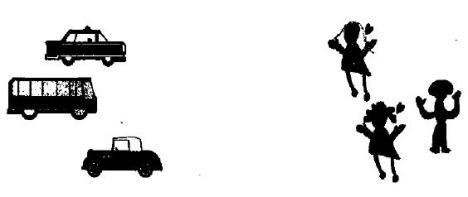
Stop for a moment before I give my take: I want to know if you see what I see.
…
Two different objects for two different children? How does this give a natural intuition of multiplication?
I can guarantee without even giving the experiment that the first model would be more successful than the second, but it’s more a matter of a badly-formed example than a true comparison of the concept they’re aiming at.
More importantly, it doesn’t match how I’ve seen multiplication depicted in education. Repeated addition tends to be more like:
Frank bought a $3 sandwich every day for four days. How much money has he spent total?
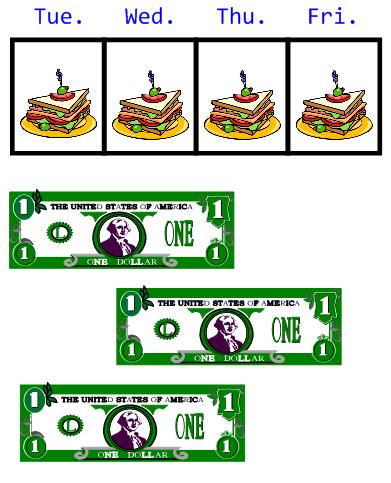
Repeated addition intuitively yet — one can think of the exact same problem with the “correspondence” model given above. If given without commentary, one would not know which model it would fit.
Yesterday, in the supermarket, a customer dumped a whole basket full of power bars on the counter. The checkout counter person started to scan them in, one by one. After seeing about seven of them scanned, with a lot more to go, the customer piped up: “they are all the same!” The checkout person laughed and started to count them.
(This was part of a thirteen part series on multiplication by Bert Speelpenning.)
That is, if Frank has bought 10 power bars worth $2 each, how much money has he spent? The motivation here is again entirely by repeated addition, but there’s no reason 10 power bars can’t match with pots and $2 can’t match with tomatoes. Furthermore, in terms of a mental arrangement, it’s much more common to have a geometric sort of layout:

That is, verbally one might describe the situation as repeated addition (due to the natural situation) but cognitively perhaps something else is going on. (Which consequently suggests some awareness in teaching the topic is warranted … but that’s a topic for my longer essay.)
I’m reminded of that article from Nature from last year which tried to assert abstract examples were better than concrete ones by making a badly-formed concrete example and then surprise — of course people are confused! I have gathered educational researchers occasionally make the questions of their experiments in a “value neutral” sense, that is, as long as the letter of the definition of the concept is followed, it’s valid. This ignores the other intrinsic qualities that make one example clearer than another. Even something as small as using boats as an example in a landlocked area vs. one next to the ocean can have a cognitive influence.
Something else I found curious about the paper is it doesn’t match with the recent efforts (spawned by the original Devlin essay) to rid multiplication of repeated addition. Joshua Fisher tried a model based on the geometry of a grid, while Maria Miller tried to follow Mr. Devlin’s suggestion of multiplication as a scaling factor. However, if the “correspondence” model given in the research paper truly avoids repeated addition, then (from my personal textbook knowledge) teachers don’t need to change their examples at all. Is the “addition” model given in the research is perhaps one that used to pop up in British textbooks? Were we all even arguing about the same thing?
If you’re curious: while it wasn’t up at the time of the controversy, someone has since uploaded the research paper to the Internet for all to read.
Filed under: Education, Mathematics |
 The Number Warrior
Thank you for a good addition to the discussion. I agree that second picture (the cars and dolls) is poorly designed to teach multiplication, even if one is using the repeated-addition model.
The biggest problem I see with the idea of “repeated addition” is that (depending of course on how it is taught) it feeds the confusion I see in my elementary students when they deal with word problems. They get a brain freeze. They stare at the problem, and then they ask, “Do I add or multiply?” Clueless.
I think, whatever model we teachers (or our textbooks) are using, we need to help our students notice this key feature of multiplication: There is a “this per that” relationship. 3 tomatoes per pot, or 3 toys per kid, or 3 dollars per sandwich… these are the things that make us think “multiplication” rather than “addition.” The tomatoes and pots picture makes this relationship clear, while the cars and dolls picture hides it.
It often happens as you describe with the power bars, that a situation can easily be viewed as addition or multiplication. Both perspectives are equally valid, but one is more efficient. If I can get my students to recognize that and to notice the “this per that” relationship when it appears in a problem, then I will feel like I’ve done a decent job teaching.
Sadly, elementary students aren’t the only ones to be unsure whether to add or multiply in word problems.
I’m having trouble seeing things like 12 inches x 12 inches as repeated addition…. what ever turns them into square inches…
It leads to the problem I mention here
The “inches * inches = square inches” point seems quite useful in explaining why the distinction is needed.
I think there is an intermediate step that is often overlooked when calculating area. At least, this is the way I try to explain it to my students: We start with length measurements, and then we need to define our unit of area before we can use these measurements to calculate the area of our rectangle. (I always start with rectangles. Does everyone do that?)
12 inches x 12 inches = 12 x 12 x (1 square inch)
Now we have 12 rows of 12 square inches, which can be seen as repeated addition if one really wanted to. But it is also easy to imagine what would happen if the calculation was 12.5 x 12.5 (we’d have extra partial rows), so we can stretch our understanding to rational and real numbers.
This is a very good point. As I’ve mulled over this, whether the repetitive addition method would only actually refer to operating in a single, linear dimension. If you were operating in 2D or 3D, the repetitive addition idea does not work due to the unit value changing, such as square inches or even cubic inches.
Please remove the word ‘whether’ from the above comment.
There is another significant failure in the multiplication as repeated addition: FRACTIONS. It should be no surprise that elementary students have difficulty in this area, since the addition of fractions and the multiplication of fractions do not lend themselves to similar models of teaching. I would be most interested if anyone knows of a model that uses the repeated addition to teach fractions which overcomes this problem.
To be fair, I don’t think anyone was arguing you could teach fractions with repeated addition; rather, they were using it as an initial model in the age range before students encounter fractions. Really there were two strands of debate:
a.) arguing that with Peano arithmetic, one can create multiplication on the natural numbers by repeated addition vs. arguing that thinking of multiplication as repeated addition is always wrong mathematically
b.) arguing that it was fine to teach multiplication as repeated addition as an educational introduction, and that it would be “augmented” the same way negative numbers etc. get gradually added to a child’s number system vs. arguing that it leaves harmful misconceptions to equate the two concepts that way at any point in a child’s education.
“I would be most interested if anyone knows of a model that uses the repeated addition to teach fractions which overcomes this problem.”
Sure, just change the base to the LCD and then you can synthesize multiplication with addition again. This is the same idea that makes the slide rule so powerful.
[…] Jason Dyer revisits last summer’s hot topic of controversy in The “Multiplication is Not Repeated Addition” Research. […]
Nothing says summer like multiplication vs. repeated addition.
Look forward to your “ultimate” post.
One quick point, because I can’t resist:
It’s important, I think, to keep in mind Park and Nunes’ purpose in the study you cited (which I uploaded to Scribd). They wanted to see which understanding the origin of the concept of multiplication is grounded on–repeated addition or correspondence. They did not intend to test which understanding “worked better” to help students “learn” multiplication.
So, they didn’t “teach” (sorry for all the quotes) correspondence-as-multiplication or repeated-addition-as-multiplication (at least, that was not their intention). They “taught” correspondence by itself to one group and repeated addition by itself to another.
I disagree, then, that the repeated addition example from the study that you posted is a bad one. It shows exactly what it was supposed to show. It is an example of repeated addition–by itself.
“Nothing says summer like multiplication vs. repeated addition.”
LOL!
[…] Jason Dyer revisits last summer’s hot topic of controversy in The “Multiplication is Not Repeated Addition” Research. […]
Forgive me for being woefully late in adding my thoughts to this article, but I’ve only just stumbled upon it.
I’m a computer scientist, by profession, but I’ve always taken an amateur interest in expanded mathematics, and I’ve always enjoyed the magic of numbers. As such, I find myself confused at the distinctions drawn between Addition and Multiplication in Mr. Devlin’s articles. Perhaps there’s something I’m missing (and if so, please help me understand it).
Mr. Devlin and others have specifically pointed to fractional arithmetic at being the point at which Multiplication ceases to perform as Repeated Addition. However, I’ll contend that the conceptual problems to which he alludes come as a result of the common notation used to describe the math, and are not inherent in the math itself. Let’s take, for example, the problem of three fifths multiplied by four sevenths. Most of us would not hesitate to quickly write this as . This, of course, causes problems because it is conceptually difficult to add
  to itself
  times. The units simply don’t make sense.
However, that is not because the Multiplication involved is suddenly no longer Repeated Addition. It is due to the fact that our notational system utilizes explicit shortcuts. Yes, we can calculate the expression much more quickly by multiplying numerator to numerator and denominator to denominator, but that does not change the fact that we are essentially adding together twenty sets of 21, where our unit is one thirty-fifth.
Now, I can understand a desire to find the best method of teaching multiplication to students, especially if one feels the current method does not prepare them adequately for higher math; however, it seems disingenuous to me to claim that Multiplication is not mathematically the same as Repeated Addition, based on the arbitrary use of certain units and notation. Is there really any case in mathematics in which Multiplication cannot be solved through the use of Repeated Addition?
I do have an extended answer to your query, so if you’ll be patient I will be posting Is Multiplication Ever Mathematically Equivalent to Repeated Addition? where I untangle what Mr. Devlin is being all fussy about. (Short answer: he considers multiplication to be not multiplication unless it is done in an integral domain. There is at least some logic to this but it requires an explicit philosophical standpoint which he never makes clear.)
There is an easier way to explain this.
Do not confuse operation (procedure) with an operation’s purpose. Repeat addition (or skip counting) is a procedural way to calculate the answer to a multiplication problem.
But it only works because you know how many times to count…when to stop counting. This extra information is not contained in an addition problem. In an addition problem you only document 1 factor. The other factor is implied by how many times you are adding it. So there is no way to invert the calculation, without keeping that implied information as a side note.
But both factors are formally contained in a multiplication problem, which is why it is reversible.
In response to Keith Sherwood on Dec 6, 2010 at 1:16 pm.
(I know it’s an old post, but I’m bored)
There are two factors in an addition problem, a+b. Until I have my addition facts learned, I would start counting from a until I said b more numbers (saying the words while counting on my fingers).
How are both factors contained in a multiplication problem? How does this make it reversible? Why is addition not reversible?
If were were playing Jeopardy and I choose the Addition category, and Alec says, “8.” I have little shot at guessing the answer “What is 2+6?” There are many other ways I could decompose the answer using addition. The same is true if it was a multiplication problem (1*8 or 2*4).
Mr T.
Your terminology and line of reasoning are running amok! I think this will make sense if we both use the same terminology, and address one component at a time. Let me try to address your talking points first:
“There are two factors in an addition problem, a+b.”
On this topic, mixing terminology will confuse people. Addition contains NO factors at all. Addition contains addends.
Factors are specific to multiplication. In In multiplication, one of the factors is the Multiplicand, and the other factor is the Multiplier.
If you are using a repeated addition as a method to calculate the result, the multiplier tells you how many times to add the multiplicand to itself:
3 x 4
3 + 3 + 3 + 3 = 12
3 is the addend
4 is the augend
12 is the sum
If you are using a multiplication algorithm to multiply, then the multiplier is the conversion factor:
3 X 4 = 12
3 is the current unit count (3/1)
4 is the conversion (or scaling) factor (4/1).
12 is the product (12/1)
Every unit in the multiplicand is converted (or scaled) to 4 by the conversion factor:
3/1 * 4/1 = 12/1
Addition is a form of counting; the amount changes.
Multiplication is a form of conversion; the amount does not change, only the units do.
1 cup = 1 of 1 unit
8 ounces = 8 of 1 smaller unit.
Same amount, different scale.
Since the amount is the same, and the units are smaller when converting from cups to ounces, the unit quantity must increase, even though the amount does not (1 cup is the same amount as 8 ounces).
“How are both factors contained in a multiplication problem?”
Addressed above.
“How does this make it reversible?”
Look up the following for definitions, and check my post further down the page, dated October 2:
* Properties of Equality
* Multiplicative equality
* Multiplicative commutativity
* Multiplicative Inversion
” Why is addition not reversible?”
Addition is reversible. But using ‘repeated addition’ as a multiplication method is not reversible unless you keep track of the multiplier somehow. As soon as you introduce a conversion factor which tells you ‘how many times to add’, you are doing multiplication, not addition. Addition as a calculation method for multiplication is multiplication, and not equivalent to addition.
“If were were playing Jeopardy and I choose the Addition category, and Alec says, “8.” I have little shot at guessing the answer “What is 2+6?” There are many other ways I could decompose the answer using addition. The same is true if it was a multiplication problem (1*8 or 2*4).”
Sorry, but i fail to see the relevance of these statements in the context of this discussion. Could you please clarify how this supports your premise of multiplication as being the same as repeated addition?
My humble opinion is that Devlin made a huge fool out of himself and for some reason the mathematical community decided to pretend it never happened.
Multiplication on real numbers IS repeated addition. It’s so MATHEMATICALLY. It’s the standard way to DEFINE multiplication on integers in foundations of mathematics. And it can be easily extended to all real numbers (infinite sums).
Furthermore, kids first learn multiplication on natural numbers, NOT fractions or real numbers. Teaching kids multiplication over natural numbers WHILE telling them multiplication is not repeated addition is IDIOTIC. The kids would never trust another word the teacher says.
What Devlin in effect advocates is that we should LIE to kids initially so that we can PRETEND later on that some conceptual problems do not exist.
Well he should start by outlawing the term MULTIPLY since in ordinary English it usually means to become more numerous (e.g. the Biblical go forth and multiply).
Why Devlin gets away with his crap is a mystery to me. I guess it’s because he wrote 50 books on far too many topics than he can truly understand.
It’s more complicated than that.
Messages like this mean I _really_ need to finish my next post, which I’ll try to do this week.
In short (although he unfortunately never makes this clear) while Devlin acknowledges the existence of Peano Arithmetic et. al. and building multiplication off of them, that the number system is not the one we use until we reach the level of integral domain and by then our definition has to be changed.
In fact, problems start happening as soon as one adds 0. Here’s a quote from a number theory book:
The idea we followed in the last chapter was that muliplication was repeated addition, and so 2 * 3 told us when to add 3 2’s together. The idea easily covers 0 * 3. It tells us to add 3 0s together. But, using the definition above, (0 + 0) + 0 = 0 + 0 = 0, so 0 * 3 ought to be 0.
There is more of a problem with 3 * 0 however. If we apply our basic idea, we find ourselves adding together 0 3s. We have no 3s (or anything else) to work with, so we certainly can’t get a number for an answer. Our original motivation isn’t sufficient to cover this case.
…
Now, in this case, the modification is slight, but things start to get worse later.
What’s going on, essentially, is a difference of philosophy of mathematics. Either standpoints has possible arguments. I promise I will finish my full exposition soon.
Just want to do simple correction..
In Math, 2*3 means 2 groups of 3 or we can say add 2 3’s together..
3 * 0 is not a problem for repeated addition as long as you have always started with the additive identity, 0.
First, let’s be specific and point out that 2 * 3 is not just 2 + 2 + 2, but rather 0 + 2 + 2 + 2. That way there are three bounces on the number line.
Then, 3 * 1 would be 0 + 3 and 3 * 0 would just be 0, because you always start at the additive identity and then add 3 zero times.
What’s going on is that Devlin PRETENDS to have the objective truth on this and PRETENDS that anyone who disagrees is factually wrong.
No amount of philosophizing is going to change that.
And on real numbers multiplication IS repeated addition in a way that most mathematicians would recognize as valid. That you have to extend the concept of sum to empty or infinite sums is obvious, but so what? This is entirely common in mathematics. And once again, it already occurs with the term MULTIPLY, the meaning of which needs to be EXTENDED to products like 3×1 (or 1×3?) by kids.
Devlin is utterly lost, as evidenced by his three confused articles. Why else would people like you need to go to such lengths to try to find some remote specks of sense in his diatribe?
I’m going to guess you’re not seriously suggesting 3.5 * 2.6 or are modeled by repeated addition, but rather you just mean natural numbers, right? (Note of course we are only talking about addition and multiplication then; as soon as we add division we get 3.5.)
(Extra thought. Or maybe you are implicitly doing scaling, considering multiplying 3.5 as adding something 3 and a half times. But that isn’t quite repeated addition, although I see how one might semantically make the switch. Hmm.)
I agree the three articles were somewhat muddled, but as I’ve pointed out, he is not insane, simply he requires an integral domain before he consider the process being worked with “arithmetic”. That he was never totally clear about this was unfortunate, and I do think his insistence on considering more primitive arithmetic (that’s a technical word, not a insult) simply invalid is frustrating.
Of course 3.5 * 2.6 or pi * pi can be modeled by repeated addition.
Multiplication on fractions in particular is typically DEFINED by repeated addition. One third is the number q that added 3 times equals 1. One third times 5 is the number q that added 3 times equals 5. Two thirds times five fourths is the number q added twice, where q is the number that added 3 times equals five fourths. See http://math.berkeley.edu/~wu/NMPfractions4.pdf for a *mathematican’s* definition of multiplication on rational numbers that is modeled on repeated addition.
As for irrational numbers, they are limits of sequences of rational numbers, and their products are limits of sequences of products of rational numbers… in others words of repeated addition.
So yes you can model multiplication on real numbers by repeated addition and this is indeed a natural way to extend the concept from natural to real numbers.
Of course students would make no sense out of this until they truly understand irrational numbers, which means truly understanding limits of infinite sequences. That is why the geometrical interpretation as an area is preferable, though only AFTER students encounter the REAL LINE. And of course it can be shown easily for natural numbers, and fairly easily for fractions, that this is equivalent to repeated addition.
As to scaling, please give me PRECISE mathematical definition of scaling to be used A) in 2nd grade and B) in middle school. Understandably the definition in elementary school can be less abstract than in middle school, but must suffice for intuitively clear proofs of multiplicative properties — the way repeated addition and rectangular areas suffice at these levels (respectively).
I’m a little clearer on your standpoint here, thank you.
The issue that you’re not realizing is that Devlin is essentially ceding your mathematical point but _still claiming multiplication is not repeated addition_.
That is, he would argue while one “builds up” with addition, and forms a “natural” extension as you say, this extension is not *identical* to repeated addition.
If this seems like a strange nitpick, well, you might be right. But again, I said, it is a philosophical standpoint; he is claiming even though an extension might be “natural” it is still substantially different enough to deny isomorphism.
Basically: do you view structures like “integral domain” as of the whole cloth, and any “primitive” versions of that as side effects, or do you consider mathematics to be “built up” from the primitive concepts?
As to scaling, please give me PRECISE mathematical definition of scaling to be used A) in 2nd grade and B) in middle school.
Now, all this is separate from the educational issue. I agree the “scaling factor” thing can be dodgy (see Maria’s post linked in the main text of this post) and this very post addresses another one of the replacements candidates which seems to be a bit muddled.
(Also, nice article. Thanks for linking to that.)
“As to scaling, please give me PRECISE mathematical definition of scaling to be used A) in 2nd grade and B) in middle school.”
Scaling is the conversion of units of the same type, such as distance, from larger to smaller (multiplication), or smaller to larger (division).
Please let me know how you feel this falls short, and I will try to bring this closer to what you are after.
Of course, based on your cynicism toward Devlin, I am not sure if you are looking for a definition at all, but possibly for additional refutation of his premise.
But that is fine if so. I think a precise mathematical definition would be useful so I am interested in developing it if possible.
I realize this is an old post, but it is still a hot topic and people are still posting to it so I am posting a response to this thread.
You can say what you want about Devlin…but I have not seen a single person including yourself explain the principle issue with using addition as a procedure to perform multiplication.
So here it is: Repeat addition or skip counting only works for solving multiplication problems because you know how many times to add. But this extra information is not contained in an addition problem. In an addition problem you only document one factor. The second factor is IMPLIED by how many times you are adding it. So there is no way to invert the calculation without keeping that implied information on the 2nd factor as a side note.
But both factors are formally contained in a multiplication problem, which is why it is reversible with division.
The reason folks are going astray on this is because they are asking the wrong questions. Asking if there are scenarios where repeat addition breaks down as an OPERATION is leading you away from the key issue of what multiplication IS.
The questions you should ask are: What is multiplication? Why does it exist? If it is the same as repeat addition, why do we even need it? Do we really need more than one way to perform addition?
When I was struggling to help my kids with math, especially in 4th and 5th grade, these questions led me to the exact same conclusion that Devlin arrived at. It was months after I came to this realization that I found Devlin’s article. But I am not a mathematician…I am not even a genius.
Here’s how I explained it to my kids: With addition, the quantity changes. With multiplication, the quantity stays the same. Yes, I just said multiplication does not change the quantity. Here’s why: Multiplication and division are for unit conversion. That is how you know you need to multiply or divide…when the units need to be converted. This one concept will solve most of your issues with tackling word problems; look for the units and see if they are being converted.
It is simple. If you convert ounces to cups…are you changing the quantity? No. 8 oz = 1 cup. When you multiply, you are actually splitting the units into smaller ones. When you divide, you are combining or grouping smaller units into larger ones. But you are not change the total quantity of “stuff”. The numbers change because the units change.
This is why multiplication and division were invented: To solve problems with different size units. The philosophical stuff came LATER, in an attempt to understand it, to build on it, to develop higher math like algebra. You don’t really think that Peano invented multiplication do you? And so leaning on mathematician’s definitions to explain multiplication is putting the chicken before the egg.
This one concept will solve most of your issues with tackling word problems; look for the units and see if they are being converted. If so…guess what: you need to multiply or divide.
The reason everyone thinks the quantity changes is the exact opposite of what we are debating. It’s because they use multiplication to perform repeat addition. And in addition, the quantity does change. So the whole thing so hopelessly muddled that it has degenerated into a philosophical discussion.
So trash Devlin all you want, but I wish I had found his article before spending literally months working it out for myself. But I had to do it, because I could not found a single teacher that could help my daughter with math, because tutoring is just more of the same. She failed 5th grade math, because the way we teach math fails. But she thought she thought it was her, that she was stupid and it crushed her confidence. I worked with her on this concept and now in 6th grade she is blowing through algebra with ferocity, scoring 95 or higher on ALL her math tests. Clearing this up for her allowed her to master word problems and fractions, and now to understand algebra.
So here it is: Repeat addition or skip counting only works for solving multiplication problems because you know how many times to add. But this extra information is not contained in an addition problem. In an addition problem you only document one factor. The second factor is IMPLIED by how many times you are adding it. So there is no way to invert the calculation without keeping that implied information on the 2nd factor as a side note.
I don’t have time to discuss the rest of the comment but I wanted to point out this argument isn’t entirely solid.
(Computer science mode on)
Let’s suppose you have some function f(x,y) on a computer that returns the result of x times y.
You are claiming, essentially, that if the internals of the function keep a “local variable” that is a counter for how many times the number is added, that it makes the operation invalid. However, multiplying and dividing on a computer always require _some_ kind of internal algorithm. There’s no way to tell the computer to “just multiply”, sooner or later there’s going to be an operation involving addition somehow, just not necessarily of the repeated kind. (Most computers use a “shift and add” method because shifting is a very fast operation inside the physical space.)
Now, you might protest we’re talking about the “pure” version of the mathematics here without the internals, fair enough: but in that case the function will be a black box anyway, so it doesn’t matter what goes on in the inside.
But! you might protest again, the inverse operation won’t work the same way! Well, certainly it can, you just would have an internal counter representing repeated subtraction. Implementing division will again require some kind of internal counters no matter what algorithm is used.
(Computer science mode off)
Having said all that, making inverses clean is clearly a good reason to think of multiplication and division as entirely separate from addition and subtraction, but that only works in “mathematician mode”. Computer scientists — those thinking at the level at actual implementation — think that the mathematics don’t make sense without the internals. One thing to be clear about though is that there are many algorithms for multiplying, but only one operation of multiplication itself. The many-algorithm issue is one reason why saying the algorithm and the operation are “equivalent” in some sense is dodgy.
Jason, for some reason I could not reply directly to your post so I have to reply to my post.
You are using two points to refute my supporting argument that repeat addition is not multiplication.
My argument is that addition and multiplication are two fundamentally different “things”. Addition is fundamentally counting (the quantity changes) and multiplication is fundamentally unit conversion (the quantity does not change).
So first, you are saying that because computer algorithms use addition to multiply, and they cannot be told to simply “multiply” without some form of adding, that multiplication really is a form of addition at the most basic level, and that this reduces my argument to “mathematician-mode”.
I am surprised that you didn’t simply point out that the algorithm for multiplying by hand actually uses addition as soon as you have factors with two or more digits.
I think it is pretty clear that ALL multiplication algorithms introduce some form of addition to calculate the final result.
I feel that multiplication is actually table-driven, the results of which are added together via an algorithm (for multi digit calculations). So the actual operation of multiplying is probably more akin to a lookup than a calculation.
But it does not make any difference. Here is why: None of the algorithms teach kids what multiplication IS. Telling them that repeat addition is multiplication, or that shift and add, or a Slansky adder, or anything else from an algorithmic standpoint is multiplication, does not help them to THINK with multiplication or solve problems. This is what the rest of my post was talking about (the part that you did not have time to discuss).
Here is possibly a better way to explain it. Solving a problem such as a word problem, requires developing equations (or inequalities) to describe or model the problem. If our kids do not understand what multiplication IS (unit conversion) they will not be able to create the correct equation. Help them understand it well enough to create the equation, and they wont care how you tell them to calculate the result…repeat addition, counting on their fingers and toes, whatever.
Which brings up your second point:
“The many-algorithm issue is one reason why saying the algorithm and the operation are “equivalent” in some sense is dodgy.” I never said that they were equivalent, and I never implied it.
What I said was “the principle issue with using [repeat] addition as a procedure to perform multiplication” is that that you have to record the second factor to make it equivalent to multiplication.
You took this to mean that I am equating the operation and the algorithm. But if you re-read it you will see that I did not say that at all. In fact, I went further and pointed out that multiplication was invented to solve specific types of calculation problems, and using definitions put forth by mathematicians as a way to explain what multiplication IS, creates part of the confusion around the topic.
All in all, I do not think your response was a fair assessment of my argument, and I do not think that you acknowledged the potential value that this has for teaching math.
Er, you might want to reread. I was pointing at issues with one particular argument that doesn’t really have to do with unit conversion. Your overall idea that you are reiterating is sound (and has been mentioned elsewhere in the midst of when there was a massive flamewar on all this).
(In your new post, “multiplication is table based” doesn’t make much sense. It certainly isn’t defined mathematically that way, nor is it done internally in computers that way. But again, it doesn’t affect the overall idea.)
Jason Dyer, on December 8, 2010 at 8:33 am said:
Er, you might want to reread. I was pointing at issues with one particular argument that doesn’t really have to do with unit conversion. Your overall idea that you are reiterating is sound (and has been mentioned elsewhere in the midst of when there was a massive flamewar on all this).
So if I understand correctly now, are you saying the idea sounds OK, but that multiplication IS addition at a fundamental level?
If so let me address this one issue then. I actually like your idea of using computing as a way to think about it. We just have to be careful that the extra layer does not obscure something.
1. (You said) You are claiming, essentially, that if the internals of the function keep a “local variable” that is a counter for how many times the number is added, that it makes the operation invalid.
No, I am essentially claiming that doing this invalidates the operation AS ADDITION…doing this makes it a multiplication operation that uses addition in the algorithm (see #3 for why).
2. (You said) However, multiplying and dividing on a computer always require _some_ kind of internal algorithm. There’s no way to tell the computer to “just multiply”, sooner or later there’s going to be an operation involving addition.
Yes. BUT, all multiplication operations also involve factors in some form. This is part of the reason for the ongoing debate: If you are going to say addition is always required don’t forget to say the factors are always required as well.
3. …you might protest we’re talking about the “pure” version of the mathematics here without the internals, fair enough: but in that case the function will be a black box anyway, so it doesn’t matter what goes on in the inside.
No, it does matter, but not because of pure math VS implementation. It matters because the only way you get to the correct answer is by using the correct factor. As soon as you introduce a factor in ANY form, you are no longer performing the operation of addition, you are performing the operation of multiplication. Multiplication has a limit constraint expressed by the factor (and division has a limit constraint expressed by the dividend). So it is this EXTRA information that differentiates the operation of addition (counting) from the operation of multiplication (conversion) at an implementation level.
For example, if a computer were to use repeat addition to multiply, in calculating 2*3=6 it must calculate +2, 3 times, or +3, 2 times. This has to happen BEFORE it is able to display the solution as a repeat addition calculation of 2+2+2=6, or 3+3=6, because it is a translation from one calculation form to another. The translation REMOVES a factor and replaces it with multiple adds. Now it is performing the operation of addition. Using shift and add is the same thing, since the number of shifts is determined by the factor. It is not repeat addition but it is still translating the calculation from a multiplication operation to an addition operation and removing the factor.
4. (You said) In your new post, “multiplication is table based” doesn’t make much sense. It certainly isn’t defined mathematically that way, nor is it done internally in computers that way. But again, it doesn’t affect the overall idea.
Agreed, it does not affect the overall idea. As far as it not making sense, this was an attempt to find some different way to express what happens when we multiply. While multiplication might not be defined mathematically as table-based, it is taught that way and our hand-calculation algorithm is based on knowing those multiplication tables.
The reason I went this direction, and I am not totally sure it will hold water, is that multiplication is axiomatic at a single digit level. 2*3=6 is more like an axiom than an actual calculation algorithm.
For multi digit multiplication, if you are not able to either remember the multiplication facts, or look them up in a table, you cannot use the hand calculation algorithm to multiply multi digit numbers (you could calculate them on the side, but that is extra, not part of the algorithm).
It was your comment that you cannot tell a computer to “just multiply” that spawned this thought. If you cannot tell a computer to multiply, then you have to either calculate some of it on the side (using shifts or variables for the factors), or use tables (or arrays) to look up parts of the calculation. This seems to make sense, at least as a visualization. Curious of your thoughts on this, but I realize it might not bear fruit.
If you want to know my overall opinion of the mathematical portion of the matter, I did make a second post which addresses that directly.
The fact is that in 1913 it was proven that all math is simply a special case of addition. This proof is the basis for the digital computer. If you wish to say there is some mathematical function that is not essential just a special case of addition, a good first step would be to show how it cannot be reproduced with a computer.
Sheffer, H. M. (1913), “A set of five independent postulates for Boolean algebras, with application to logical constants”, Transactions of the American Mathematical Society, 14: 481–488
And keep in mind there’s a world of a difference between saying multiplication MUST be viewed ONLY as repeated addition, and saying that multiplication CAN be viewed, among other things, as repeated addition.
Teachers who are unwilling to present multiplication ALSO as, say, Cartesian product, or geometrical area, or scaling, certainly should be criticized. But this is NOT what Devlin has done. He says ANY teacher, even in 2nd grade, who presents multiplication as repeated addition, is an ignoramus spreading falsehoods.
Again, no amount of philosophizing is going to make Devlin any less of a fool than he already made himself in this matter.
I should point out the subtlety that he *thinks students should discover the particular case of addition being repeated multiplication in the context of a more general definition of multiplication* and not that he wants the thought excised altogether.
Mind you, there are reasons to believe he is wrong in this, but there are opposing reasons as well that don’t involve just being ornery.
I should leave you with, though: in essence we are just talking about sequencing: should we take a general case and then find interesting things about the special cases, or should we start with special cases which may involve more intuition and work our way up?
Jumping in even later, here, but when I browsed for Stuff Online To Help Teach Multiplication, I kept colliding with videos that stressed as this does (http://pbskids.org/cyberchase//parentsteachers/show/episodes/119.html )
“relax! Multiplication is just repeated addition!”
Same story with a video on http://www.multiplication.com .
I do think that Devlin doesn’t realize that yessirree bob, many people *do* start building that multiplication concept with repeated addition. WHat goes on in his grey matter may be different — or he may have forgotten. Lots of folks have started with that and not been forever crippled by it.
Jason, every irrational number is the limit of a sequence of rational numbers. It is so in a trivial manner: see Cauchy sequences and thinks decimal expansion.
As to “integral domain” I think it’s a red herring here and really has little to do with Devlin’s rather silly and demeaning attack on so many teachers.
Chaitin’s Omega?
Sorry, I was thinking of computibility here. You’re right otherwise.
If you want to distill his argument into “natural extensions are not isomorphisms”, it doesn’t matter. If you want to think he’s being silly about that, fine. But that needs to be the target of counter-argument.
[…] Last year I wrote about a kerfuffle of the mathematical portion of the Internet over a series of three articles by Keith Devlin that claimed not only that teaching multiplication as repeated addition was not only wrong, but outright harmful. […]
[…] in the draft is coming from this paper mentioned in the bibliography of the standards, also mentioned by supporter of multiplication-as-repeated-addition in one of my posts. Therefore, before anyone starts throwing flaming rocks, I’d recommend […]
[…] this link to know what others say about multiplication is/ is not repeated […]
The practical problem with teaching multiplication as repeated addition, is that it does not help kids to defeat their nemesis: word problems.
See, teaching the repeat addition instead of the scaling model muddles kids understanding of what multiplication was created for.
Start with a simple question that any thoughtful student might ask: “Why does multiplying or dividing both sides of an equation, or both parts of a fraction not change the solution?”
The answer is that multiplying and dividing do not change the actual amount…they only change the units of measure. See, it works because 1 cup is exactly the same amount as 8 oz. The quantity only changes because the units change.
See, multiplication tracks the scaling factor…repeat addition does not. So the fact that repeat addition might give you same same answer overlooks the fact that there is no way to record the scaling factor as part of the operation…but multiplication does…that is it’s purpose, because you might need to change the units again.
So dividing or multiplying does not change the amount…only the units of measure. This is the scaling factor that Devlin is trying to explain.
Once a kid understands this, word problems suddenly become understandable. When the units change, I need to multiply or divide.
So do your kids a favor and teach them what multiplication IS, so they can think for themselves. Otherwise, they are reduced to solving problems they have already seen and when a new problem presents itself, they have to rely on the teacher to explain it instead of working it out themselves. For cryin’ out loud people do you not remember how painful it was for you to learn this? Think about it.
-ks
I could have swore Keith brought put up the units issue in one of his original articles, but now that I reread them I’m missing it.
Anyway, I’d certainly be careful on relying on ‘the units convert’ as an end all to understanding multiplication. For one thing, there’s the difficulty in knowing whether to multiply or divide, like in this article:
For instance, 12 to 15 year old pupils were asked how to find the cost of 0.22 gallons of petrol if one gallon costs 1.20 pounds . . . The most common answer was 1.20 / 0.22. When the same question was asked again with “easy” numbers, such as 2 pounds for the price of a gallon and 5 gallons for the amount of petrol, the pupils answered correctly. 2 x 5. When interviewed, the pupils did not consider it incongruous for the needed operation to change when the numbers changed.
The way to determine if you need to multiply or divide is to determine if you are converting to smaller units or larger ones. Converting to smaller units, as in this problem, requires multiplication.
This article is interesting, but did they determine why the kids made the mistake? It sure looks like they do not understand multiplication as unit conversion.
I’d be really careful expressing that as your rule. Students already think too often multiplication always makes a number get larger and division always makes a number get smaller.
Jason, could you help me understand this better? I agree that students too often think that multiplication and division alter the quantity. That understanding is what needs to change. Are you possibly saying the rule is correct, but might not be understood by students?
I do plan on responding to this one. You’re not wrong, strictly speaking — you’re using a set-model of looking at multiplication — but I want to do a proper response with pictures and demonstrate possible pedagogical confusions.
Jason, the pedagogical confusion ALREADY exists. Still, we cannot necessarily blame teachers directly, because even mathematicians do not agree.
The reason for the disagreement that I have offered in this forum is that we have failed to see that introducing factors changes the NATURE of the calculation from quantity to scaling.
You might say that mathematicians MUST define multiplication using terms other than conversion, because using conversion to define conversion is a tautology. But conversion is by its nature, self defining. You are given the conversion rate, and all that remains is to define it’s properties.
So it’s a miss because they say multiplication IS repeat addition without identifying the conversion/scaling issue when introducing factors that define the unit as a rate. Factors are meta-data. Information about information is not intrinsic, but is extra information that is brought into the operation. The result of the miss is that we only have addition based definitions for multiplication.
CONVERSION BASED DEFINITION OF MULTIPLICATION
So let me offer something that can help with the pedagogical confusion: A conversion-based mathematical definition of multiplication.
What follows with the use of reciprocals is not actually a new definition. However, the explanation of the definition of multiplication as an expression of rate, and units as rate, I have not seen before. If someone should receive credit for this, please provide that information for everyone’s benefit.
1. ALL multiplication problems are an expression of rate.
2. A rate is a relationship between two different size units or type of units (cups and ounces, distance and time, etc).
3. a * b means to ungroup or divide each of a units into b pieces (this is conversion).
4. The equivalent rate is expressed as a / 1/b (rates express conversion)
5. So a * b = a/1 * b/1 = a/1 / 1/b (multiplying is the same as dividing by the reciprocal)
6. Multiplying by a number is the same as dividing by that number’s reciprocal.
7. The inverse of this is the more familiar axiom that dividing by a number is the same as multiplying by that number’s reciprocal.
UNITS and RATE
Multiplication and division are the exact same operation, which is division. The reason they seem different is because we have forgotten that multiplication is NOT about numbers, it is about UNITS. Units can be written as a number, but they are really a RATE. Why? Because units are always RELATIVE to other units. Ounces are relative to Cups and Gallons. Miles are relative to feet, and feet are relative to inches, etc.
When you multiply or divide, the units become either larger or smaller depending on if the factor/divisor is greater than 1, or smaller than 1 (fractional).
Without the idea of measurement units, you do not have rates at all. But as soon as you introduce units, you have to realize that EVERYTHING is a rate. 2 units is actually two whole units, or 2/1. You cannot have multiplication without units…numbers are not enough, because multiplication and division are unit conversions, and conversions are rate based operations that involve splitting units into smaller ones, or combining units into larger ones.
Multiplication is written using numbers as a shorthand, because the result of the shorthand 2 * 3 = 6 is the same as 2/1 * 3/1 = 6/1 = 6
QUANTITY
Expressing a rate is not a calculation of quantity. In a rate, you are GIVEN the quantity, and you only need to perform the conversion. When we multiply 2 * 3, we are actually splitting each of the 2 units into 3 pieces, which calculates as 6.
So with multiplication and division, the quantity is not changing, only the size of the units are changing. When units convert to larger units (division), the resulting number is smaller BECAUSE the quantity has not changed. When units convert to smaller units (multiplication) the number is larger, BECAUSE the quantity has not changed.
For example, when you multiply 2 cups by 8 to determine the number of ounces, the answer is 16 indicating that there are 16 ounces in two cups. You still have the same quantity, just a different size of units.
Keith,
I agree with you that multiplication is not repeated addition. However, your definition of multiplication comes as quite limited. You use Hindu-Arabic numerals for numbers, but don’t seem to realize, or have forgotten, or simply are not consistent, that when you basically agree to zero as a number. You deduce taht “a * b = a/1 * b/1 = a/1 / 1/b”. Well, if so then (a*0)=((a/1)*(0/1))=((a/1)/(1/0)). Well, (1/0) is not defined, and consequently neither is ((a/1)/(1/0)), so (a*0) is not defined either. Except that we already recognize that (a*0)=0, in other words it is defined. You’d have to limit yourself to the positive natural numbers for your definition to work, in which case you basically stop considering “0” as a number, which has several consequences.
Your argument is interesting, but not valid in the way you are applying it. If it were valid, the same argument would apply to current definitions of multiplication as addition. See below.
I agree with you that multiplication is not repeated addition. However, your definition of multiplication comes as quite limited.
So you agree, but you are not offering your own definition to overcome the perceived limitation you describe. The actual limitation is not in my definition, but in the properties of Real numbers. See explanation below.
You use Hindu-Arabic numerals for numbers, but don’t seem to realize, or have forgotten, or simply are not consistent, that when you basically agree to zero as a number.
This is unintelligible. My guess is that you are saying I must accept zero as a number. So fine, I accept zero as a number, which now clarifies that we can use Real or Extended Complex numbers. For Real numbers, 1/0 is not defined. So any definition of multiplication based on real numbers is affected by your argument, not just mine.
You deduce (that) “a * b = a/1 * b/1 = a/1 / 1/b”. Well, if so then (a*0)=((a/1)*(0/1))=((a/1)/(1/0)). Well, (1/0) is not defined, and consequently neither is ((a/1)/(1/0)), so (a*0) is not defined either.
The current Properties of Equality are actually flawed. Multiplicative equality is not compatible with Multiplicative commutativity, and Multiplicative Inversion. So while the answer of a*b = b*a, they are not the same thing.
Here is why: 2*3 = 6, the inverse of which is 6/3 = 2. So inversion then says a*0 = 0 the inverse of which is 0/0 = a…except that 0/0 is not defined. So a*0 is not defined.
Basically, a*0 is not defined, but 0*a is defined. This applies to both my definition, and the current definition.
Here is the bottom line: If 1/0 is not defined, then you cannot have a divisor, denominator, OR multiplier of 0 (because a multiplier of zero becomes a divisor of zero if you invert it). You may have a multiplicand of zero, but not a multiplier of zero.
A way out of this is to use the Extended Complex numbers, which are the Complex Numbers, plus infinity or ∞. If you use Extended Complex numbers, then 1/0 = ∞. This means that:
a/1 * 0/1 = a/1 / 1/0 = 0/1
…and
0/1 * a/1 = 0/1 / 1/a = 0/1.
So the bottom line is that there is no multiplicative commutativity with zero, because it invalidates the multiplicative inverse…and this is true of any definition of multiplication using real numbers. To remove this limitation, you can use the set of Extended Complex numbers.
I am too late I think but… nevermind. To the last parts your comment Keith, the one on (oct 2, 2011), I would say that you are very much true that the as when you do multi digit multiplication, repeated addition logic doesnt even appear in the brain even once let alone the thought of doing that. But since I am not a neurosurgeon, nor a mathematician, but a random 10th grader without any degree in maths, but I must slap you for saying (1/0 = infinity) lol
Its “[PLUS] “OR” [MINUS]” Infinity.
1/0.000,01 = 100,000; 1/0.000,000,001 = 1,000,000,000 (leaving commas so that you can count but thats not the point.)
and so if it infinitesimally closes zero, it will be [PLUS] infinity.
But if its 1/-0.000,000,001 then it will be = [-1],000,000,000
hence as it approaches it infinitesimally closer, the numerator becomes [MINUS] infinity, and hence you a/0 = “[PLUS/MINUS]” ‘Infinity’
And I dont care what “Extended” “Complex” numbers are
But if they include -10,000,000 then they also include “Minus” infinity, cause if they dont then multiplication must be defined at the
“Infinitely” “Extended” “Complex” domain, cause else minus infinity wont hold.
And never say that a/0 is (plus) infinity, least as you’re a maths teacher.
Correction****
“Infinitely” close, not “infinitesimally”…
he he he he he…. ummm…. yes I shoud know what I am talking about… sorry for that he he he….
Jay, not sure I followed all of that, but I am not a math teacher, I am a parent who likes to see their kids do well in school. Math learning has impacted their school work more than any other subject. So I am passionate about finding solutions to teach it to them.
I should have stopped with the explanation about the incompleteness of the Properties of Equality and Multiplicative Commutativity, since the 1/0 subtopic is not significant to understanding the larger topic.
My point to Doug Spoonwood was just that division by zero affects all definitions of multiplication based on Real numbers, not just mine. So to use it to refute the concept seemed misplaced
I did consult multiple sources before posting my explanation, and many of them used the same expression. But if you feel that I was way off with 1/0 = ∞, I’ll defer to you or anyone who knows better.
So to finalize, you are saying it must be written as 1/0 = (+/-∞).
If so, fine, that works for me.
Does this mean multiplication WORD problems? Because finding the product of two pure numbers shouldn’t need the notion of rates.
Mr T, regarding this:
1. ALL multiplication problems are an expression of rate.
“Does this mean multiplication WORD problems? Because finding the product of two pure numbers shouldn’t need the notion of rates.”
I have multiple posts on this page that explain my perspective on this. Leave an example word problem and I will be happy to clarify further.
Conversion is an important application of multiplication, but hardly the only one. Trying to make it the basis for a definition of multiplication will result in huge confusion later on, when students learn about polynomials. x^3 makes no sense if multiplication is just unit conversion.
Area and volume are also important applications of multiplication at an elementary level, and at higher levels very few multiplications are usefully thought of as unit conversions.
Unit conversion should be taught, since it is an important application of multiplication, but making it the central definition is more likely to hurt than to help kids later on.
gas,
I understand what you are saying here at a high level. I think we need to look at it a little deeper to see if it truly breaks down.
First, I said multiplication is an expression of rate. Rate is a conversion from one size/type of unit to another.
So how does this apply to area, volume, and exponentiation? All three of these are the same challenge to the view of multiplication as a conversion or expression of rate. Calculation of area is two dimensions. Volume is three dimensions. Exponentiation in polynomials is calculation of multiple dimensions of equal size. It could be two as in area, three as in volume, or greater.
So when we are calculating area, we are defining a rate of two measurements, such as length to width, as a conversion into square units. So although the factors are the same units such as inches, we are converting those separate linear inches into square inches…which are different units.
Similarly, for volume calculation from linear units, we are converting to cubic units. And for exponentiation x^n we are converting from x linear units to n volume units.
Although we can look at exponentiation as a volume calculation of multidimensional space, it is usually used in calculating population growth, growth of investments, rate of radioactive decay, etc. In short, exponentiation is used in calculating certain types of nonlinear growth or change. Since nonlinear rates of change cannot be shown as simple rates, we must introduce exponentiation. To look at exponentiation as repeated multiplication is to miss the point; exponentiation is a rate.
So the idea of conversion should not introduce any confusion for calculations involving area, volume, and exponentiation.
As to calculations in higher math regarding multiplication as something other than conversion or rate, please give examples and I will try to address it as well.
Keith,
I think there is considerable value in looking at multiplication as conversion of units. In some cases this applies directly, as when the units are “official” units. So something that’s 4 foot long is 48 inches long, as 48 = 4 x 12. In this multiplication, 48 is inches, 4 is feet and 12 is inches/foot. It also works for some “unofficial” units, like an arrangement of apples in 5 rows and 4 columns. I can say I have 20 apples, where 20 = 5 x 4, where 20 is apples, 5 is rows and 4 is apples/row. In some cases, I have to stretch the point, as in computing the middle of two points as m = .5(p+q). What unit should i concoct for .5? I get similar scalar factors showing up when I integrate gt over time and get .5gt^2. What conversion would the .5 represent here?
Still, even granting the usefulness of the conversion metaphor, and ignoring any issue of whether this is historically how multiplication came into existence – the part I don’t get is why we should insist that all multiplication can be looked at and should be looked at as conversion between units. Why so dogmatic?
In an abstract sense, multiplication and addition are each separate operations with commutativity, associativity, unit elements and inverses; held together in a field through the distributive property. The distributive property can be seen as a generalization of the ‘multiplication is repeated addition’ notion.
Yet why would any of this have relevance to how the concepts (I use a plural deliberately) of multiplication develop over the years in a learner? If we’ve noticed anything from watching children learn, it is that learning is not a simple incremental additive process. It shows fits and starts, and – what looks from an outside perspective as – reversals. The way I’d say it is that unlearning is a necessary and integral part of any deep learning. Kids ideas of counting, and number, and number line, and subtraction, and on and on, all develop over time, and as far as I can tell, that’s how it should be. Do I know what counting is? I thought I did, until I found out about Einstein-Bose statistics and discovered there was plenty about counting that I’d taken for granted that couldn’t necessarily be taken for granted. Should Einstein-Bose change how kids learn about counting? Why should it?
Bert,
0.5 = 1/2. Is your contention that computing the middle of two points is not a rate calculation (and therefore not a conversion)? You still have a total quantity, p+q, and are calculating half of that quantity. So .5(p+q) = p+q*(1/2) = p+q/2…no matter how you show it, it is an expression of a rate.
The same holds true for your second example,.5gt^2. In fact, if calculus is the study of rates of change, I think everything is still consistent. I might be missing your point so help me understand that if so.
Next you said: “…the part I don’t get is why we should insist that all multiplication can be looked at and should be looked at as conversion between units. Why so dogmatic?”
So if I understand, you are asking why we should teach that multiplication is a specific thing instead of teaching that it is many things.
The reason is to help our students to have improved understanding. Memorization of unconnected concepts does not provide understanding. What I am proposing here is an integrated view of measurement/units/multiplication/division/rates/reciprocals/fractions that the learner can use to help think with math.
If I am being dogmatic about it, it is because I have failed to find a better way of explaining math to my kids. This way produced positive results. Tutoring (which is more of the same approach they receive in school), software, books, teacher meetings, staying after school, progress reports, report cards, and of course plenty of crying (the kids too), have not produced ANY positive results for us.
Next, you said: “The way I’d say it is that unlearning is a necessary and integral part of any deep learning. ”
I agree that the easiest path is not always the best path when it comes to learning. What we think of as intuitive does not always pan out in practice. Two great examples of this are the Kaminski study that determined that kids do not need concrete instantiation to learn abstract concepts, and Kornell’s findings that spacing is better than massing for memory and induction.
I am not doing these studies justice by oversimplifying, but the point is that we can be led astray by our intuitive thinking about learning. We always need to remember that results are what count. And we know that context and framework produce better results (learning) than a lack thereof. The reason is that for learning there is difficulty, and then there is desirable difficulty.
Spacing is an example of desirable difficulty. Unlearning is difficulty that is not desirable. Fits and starts are OK, but deep learning does not need to be based on learning something, and then just when we thought we were starting to understand it, unlearning it and replacing it with something else.
Here is an example of what I mean. This is just a story example but it is a good illustration of how people can learn systems of knowledge. In the story of the Karate Kid, Mr Miagi taught Daniel-san how to wax cars and paint fences. Later, he showed Daniel-san how those techniques could be used to perform Karate. Daniel-san did not have to unlearn anything, he added to his understanding, expanded it, and had several “aha” moments. Unlearning does not produce those “aha” moments, but sudden understanding does.
So unless the results show otherwise, let’s teach in a way that provides opportunities to expand understanding rather than in a way that requires relearning.
Last, you asked “Should Einstein-Bose change how kids learn about counting? Why should it?”
There is no NEED to teach school kids Einstein-Bose counting in order to enhance their understanding of math. We only need to teach it to enhance their understanding of quantum states.
Keith,
I’ll limit myself to three points.
(1) On the usefulness of looking at multiplication as something usefully explained in terms of units and conversions.
On this I agree much more than you seem to think. I think mathematics education (especially in middle school and up) could gain by using units and dimensional analysis at least as much as is done in science and science class.
see here
(2) Dogmatic approaches. Or: one size fits all, forever.
I’ll use an example other than multiplication. I know second grade teachers who insist that “subtraction IS take away”. I also know high school teachers who insist that “subtraction IS the same as addition. Just add the negative.” These are just two views in a wider spectrum. Nothing wrong with those views as such. It is the insistence that they bring to it that I have a concern about. They have arrived. They are cooked. They are done. Learning is over, for them, because they KNOW. And everybody else should just bend to how they see it, their students in particular.
And for the students, this is simply one more episode to practice their real skill, the skill that school has instilled in them more than any other: to out-guess, and to give each teacher what that teacher wants.
(3) unlearning. This is dear to my heart, so forgive me. I mean “unlearning” very broadly. Let me give an example. Suppose that the argument you are making in your posts was as clear and as convincing as you intended it. Then I would be convinced. I would now see the light. I would now think something about multiplication and scaling that I wasn’t thinking before, and that wasn’t a straight extension of what I already knew and thought about multiplication. It would be a rearrangement of what I already knew, organized differently, in a new hierarchy, with new conclusions possible, and old conclusions now suspect or plain wrong. I would have unlearned something.
Here is a short list of things that kids in math class routinely unlearn in their journey from K through 12:
* when you add something, it gets bigger
* when you see the symbol “+” you are supposed to add the numbers and come up with the answer
* the answer is the number written right after the “=” symbol
* you subtract from the bigger number
* a fraction is when you don’t have enough to make a whole
* a percentage can only go up to 100
* the axes on a graph look like an L
* straight lines fit the equation y=mx+b
* the values (labels) on the axes must be evenly spaced
* putting a “-” in front of something makes it negative
* a reciprocal is a fraction that has 1 on top.
For each of these, one could argue that they are plain WRONG, and that the teacher should make sure that wrists are slapped (figuratively) every time one of them dares to be uttered out loud. Or you could celebrate that the student seems to have reached some stable plateau for the moment, a place from which their world seems to make sense.
Bert,
So it sounds like I misunderstood. You are not advocating a specific approach to the discussion topic, but are saying that all approaches have some merit.
I suppose that is true in the literal sense. I am just not seeing a way to use this perspective to enhance my kids learning of math. It seems too similar to the way things are done in the current system which has let us down repeatedly year after year. I can’t see the benefit of simply resigning myself to the fact that this is the way things have to be. Especially when we have achieved such good results with this framework. And the fact that this framework is SO cohesive, adds to its validity not just in my mind, but in my kids minds as well.
So I think there are several possible threads to follow at this point.
* Definition and explanation of what multiplication is (repeated addition or not).
* Assessing the potential of the explanation to enhance teaching.
* Assessing the potential of the explanation to enhance understanding (ability to explain and apply math concepts).
* Assessing the potential of the explanation to enhance performance (grades, problem solving…)
* Determination of the best way to teach it (integration with curriculum standards VS supplementary “home schooling”).
* Impact to current standardized testing (if integrated with curriculum).
Keith,
Thank you. I’m not sure that the opposite of dogmatic is all approaches have merit. I’m thinking more that the best approach depends on the situation in which you find yourself. Specifically to multiplication, I am not all that interested in arguing what multiplication really IS (as if there were some Platonic thing called multiplication) and instead am very interested in the whole constellation of ideas about multiplication that students bring, and what you can do with those as a starting point. (For example, even a student that has never heard of multiplication or the word “times” may yet already have a fairly well-developed sense of “double”.)
With respect to Devlin’s bomb throwing articles, I think that literally speaking he is correct that multiplication isn’t JUST repeated addition; and yet think that his approach in bringing it up as a subject has been irresponsible, unfortunate, and exceedingly unhelpful to the whole world of teaching and education. From where I look, he is bringing sharp knives and dogma to an environment that doesn’t exactly need more polarization and controversy. I’m more interested in the careful encouragement and nurturing of ideas, more interested in the nursery than the battlefield.
Anyway, I may have overstayed my welcome at Jason’s blog, and I suggest that if there is more you want to say to me on this, that we take it elsewhere.
Well said.
Although I have a different viewpoint on Devlin, I can appreciate what you are saying.
[…] Bert Speelpenning on The “Multiplication is Not Repeated Addition” Research […]
[…] chipped in marginally on the educational question (The “Multiplication is Not Repeated Addition” Research) and solidified my opinion on the mathematical end (“Multiplication is Not Repeated Addition” […]
I am not sure where you’re getting your information, but good topic. I must spend a while finding out much more or figuring out more. Thanks for wonderful information I was looking for this info for my mission.
[…] was reading the comment thread in an old post of mine when I hit this gem by Bert […]
I think we are mostly arguing over educational semantics. Most people seem to be drawn to a particular side based on their personal understanding of math (the practical and concrete as opposed to the theoretical and abstract). I think everyone is a little to hot and bothered over this that they are missing most of the points entirely.
An operation is a process that takes some input(s) and gives back an output(s). Many of these operations (especially arithmetic) are some type of relation (typically binary relations like functions). If we look at multiplication from this perspective, yes, multiplication is not repeated addition, however, we can define multiplication BY repeated addition. I say “by” because, yes, in some ways, Devlin’s slightly overzealous argument is correct, it is not defined AS repeated multiplication. In math, that tiny word change can alter the meaning completely. The other thing that everyone seems to over look is where are we using it. Multiplication being taught as repeated addition works when we are discussing natural numbers, and for a child it should work fine.
I do not support Devlin’s opinion that we should alter the education systems so multiplication isn’t taught as repeated addition, however I also feel some pedagogical bias to treat multiplication as only repeated addition. I think that the system we have in place is fine as long as we get the point across that multiplication ISN’T repeated addition. It is just EQUAL (equal for many of you who have forgotten, means they are the same but not necessarily the same thing) to it with natural numbers.
In summary (partially because I would much rather the majority of articles and comments have conclusions):
Multiplication is NOT repeated addition;
Multiplication is DEFINED its EQUALITY to the the repeated addition of numbers;
I feel the educational system in place currently works fine, albeit could use some clarity that multiplication is BASED on repeated addition;
This issue is just a confusion in semantics, either sides are sort of right and wrong
All math is just a special case of addition. This was established in 1913. It is the basis for the binary computer. If you wish to show that multiplication or any other mathematical operation is not just a special case of addition, a first good step would be to show that it cannot be synthesized with a computer. The only thing you computer knows how to do is add.
Sheffer, H. M. (1913), “A set of five independent postulates for Boolean algebras, with application to logical constants”, Transactions of the American Mathematical Society, 14: 481–488